Craters, Cascades and Carvings

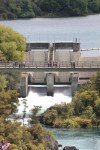
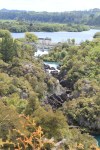
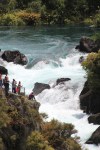
As we get ready to leave beautiful Taupo, I want to share a few other unique spots close to “home.”

Oh Deer! (and much more)

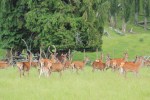
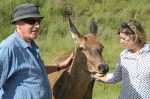
Frank was obsessed with some red deer we had seen. We couldn’t remember exactly where or when we saw them but Frank was determined to see them again. He found a YouTube video on a Kitenui Deer Farm near Taupo. Could this be the place? We drove there. It wasn’t. We saw no deer from the road. We drove down the long, wooded, gravel driveway and were approached by an older gentleman on a four wheeler. Frank explained what he was looking for and asked if the area was public. The man replied no, that he owned the land. Fully expecting him to direct us off the property, he introduced himself (Murray) and graciously invited us to pull over and he would show us some deer!

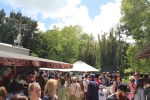
It turned out that Murray had a lot more to show us than just a few deer. We spent the next couple hours exploring some of his 500(!) acres of land, which included his art studio, an event space, some unique old airplanes (he even has an airstrip), his home and beautiful gardens (where we met his lovely wife Barbara), and finally, more animals than we ever could have imagined!

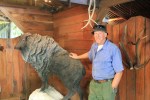
In Murray’s studio, we viewed his black and white oil paintings of the different deer species which inhabit New Zealand, as well as a few of his incredible life-size concrete and bronze animal sculptures. Several of the sculptures are exhibited in cities around New Zealand, including Taupo and another city we will be visiting (Te Anau).

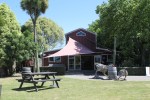
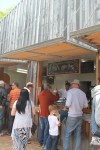
We toured a rustic building where weddings and corporate events are held. The dining area is decorated with many rifles and is illuminated with little Christmas lights, which gives the space a more intimate and old fashioned feel. The Antler Room has hundreds of (you guessed it!) antlers. Did you know that deer shed their antlers and then grow a new set? Murray is fascinated by American Indians and is an American movie buff. He shared with us that Burt Reynold’s had dined there!

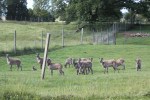
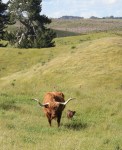
We climbed in Murray’s truck and were treated to a safari! Down the dirt road, in and out of gates, we viewed several types of deer. Some of them were more timid than others but a couple came right up to us! There was one herd of small gray deer, which were being quarantined prior to being shipped off to South Africa. In addition to deer, Murray has two American bison and a zebra! Frank and I had a lot of questions and Murray was a wealth of knowledge. We asked him if he had to worry about predators.
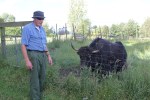
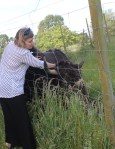
Did you know that New Zealand has barely any native mammals or reptiles? Although they have many unique native fish, insects, birds, lizards and frogs (no snakes!), the country’s only native mammals are bats, whales and seals! All other species — i.e. sheep, cattle, deer — were introduced. Farmers like Murray never have to worry about predatory coyotes, bears or bobcats!

Our “tour” closed with a stroll around Murray and Barbara’s beautifully blooming “backyard” garden. Murray explained that they had purchased the acreage more than 30 years ago. At the time, there wasn’t a tree on it and no one wanted it. Now it’s filled with life — trees, plants, animals, even two of their nine grandchildren have homes on the property. Murray and Barbara have transformed it into a truly incredible place. We were so touched he took the time to share it with a couple of strangers who wandered in off the road!

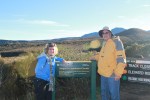
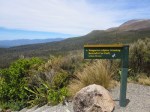
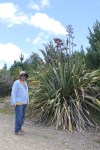
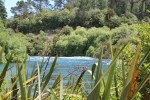
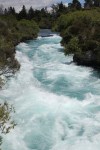
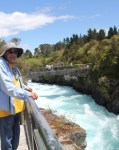
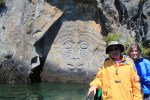
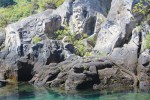
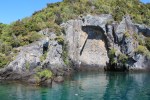
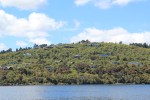
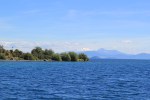
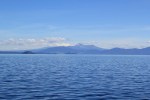
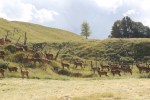
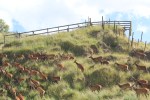
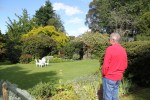
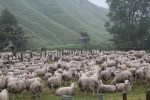
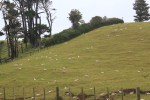
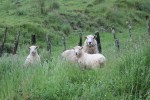
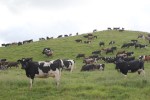
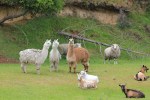
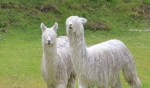
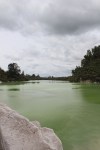
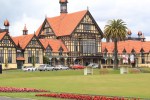
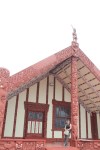
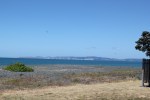
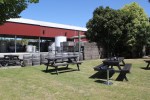
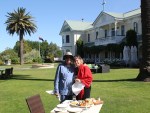
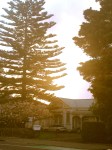
Below are a few photos from Kitenui Deer Farm and from our drives around the North Island…

Tongarir-O NO!!!!

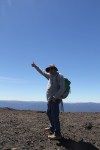
We read all the reviews describing the Tongariro Alpine Crossing — New Zealand’s #1 Day Walk and TripAdvisor’s #1 of 700 activities on the North Island; A life-changing experience not to be missed! (Lonely Planet); Lava flows, an active crater, steam vents, emerald-coloured lakes and magnificent views combine to make this an unforgettable walking journey. 

We’re right here. Is this something we should do?

We studied the guidelines:

  1. For the moderately fit and healthy (Frank swims every day. He’s had some issues with his knee but keeps it steady with a brace. I can walk forever.);
  2. You may feel oxygen deficiency (Frank and I have never had issues with this);
  3. Be prepared (We both have sturdy shoes, we could pack water, food and extra clothes in our back packs).

Finally, we studied reviews of people who had done it: Some challenging steep parts but you have never seen anything like this!; As a pretty fit 60+ year old (and I saw a good few more during the day!) I had a genuine sense of achievement when I completed the trek; Seriously an amazing walk, with every step worth the view at the top; Being of a moderate fitness level I found it challenging but not impossible and never felt like I wouldn’t be able to do; 10/10!! 

We batted it around some more. Could we handle a 12-mile walk? If we did, we could go early because it might take us longer than the 7 to 8 hour estimate. It looks incredible. It doesn’t sound too hard and we did that one big hike in Colorado, etc. etc. In the end, we decided to go for it. Frank double-checked his handy dandy weather app — sunny and warmer. Tomorrow would be the day we would hike the Tongariro Alpine Crossing!

Note to self: When you need to talk through a decision for days to figure out if you should or shouldn’t do something, don’t. Thank goodness for the pictures because today (the day after the hike), all I can remember is that yesterday we did the stupidest thing we’ve ever done . . .

We headed out for the one-hour drive at 5:30am. Having chosen the option of leaving our car at the lot at the end of the trail, we took our pre-arranged shuttle to the trailhead. It was a little chilly but Frank and I were prepared and ready to go!

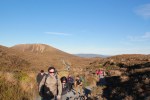
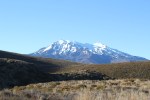
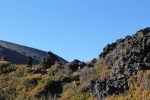
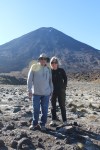
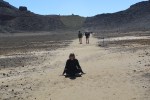
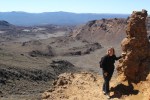
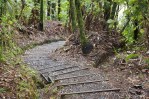
Although there were many people on the trail, the leisurely hike through the Mangatepopo Valley was quietly peaceful. We walked along a meandering stream surrounded by lava fields and lush vegetation. Majestic Mount Nguaruahoe was our backdrop as we walked along a meandering stream surrounded by lava fields and lush vegetation. The path was wide, easy to follow, even boardwalked in spots. The rising sun warmed the air and we soon shed a layer of clothing. We were so glad we decided to do this today!

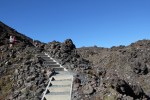
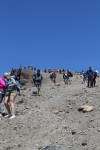
As the valley rolled into a gentle climb, the vegetation became more scattered and the lava more prevalent. A group of portable toilets signaled our arrival at Soda Springs and the impending challenge ahead – 200m (or 656 ft) up the Devil’s Staircase. Quite aptly named, it was, how shall I put it(?), Hell. While Frank nimbly climbed the uneven track and accompanying steps, I huffed and puffed and climbed and rested, then huffed and puffed and climbed and rested. He waited for me and encouraged me until we finally reached the ridge of the South Crater. The views were beautiful but the fact that I could see the hikers below and realize how far I’d come gave me the push I needed to forge ahead.

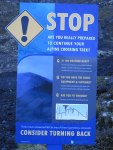
South Crater turned out to be my “happy place.” For 15 glorious minutes, the trail was completely flat. I regained my breath as we reached a sign signaling the point of no return. STOP! Are you really prepared to continue your alpine crossing trip? Having regained my mojo, I was ready to rock n’ roll. The next section was described as difficult but short, with a time estimate of less than an hour. And then we would be at the top!

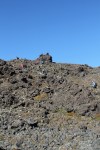
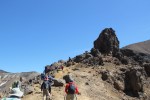
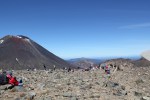
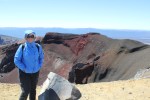
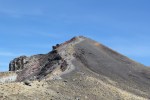
Difficult ascent? Try impossible ascent. The uneven, boulder-y track was steep with big drops off on both sides. Add a strong, chilly headwind and you get crazy SCARY! We had to figure out the best rocks to climb on and then hope they weren’t loose. One small section had a chain attached to the side of the hill to grab on to – the best part of the trek. It was well over an hour and a half of terror before we collapsed with exhaustion at the top of Red Crater Ridge. At 1,886m (or 6,187 ft), this was the highest point of the trek, as well as the halfway point. The crater, itself is stunning with its vibrant coloring. The sulfur smell makes you aware that the crater is still active. (We saw many signs warning of potential volcanic activity.)

We celebrated reaching the summit with lunch, thinking “It’s all downhill from here!” Little did we know…

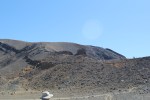
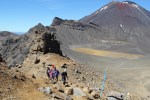
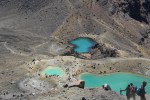
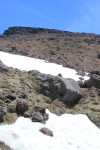
We wandered over to the other side of the ridge. Below us, in the Central Crater, we were awed by the view of the vivid Emerald Lakes. What we saw next awed us even more — the path to get down to the lakes, our path, was straight down! The map said Easy Descent. The website which I am reading now says, “The descent from Red Crater requires some coordination and balance due to the volcanic ash and scree underfoot. From this point you will be descending just over 1000m in altitude most of which is a good steady gradient.” Can you say “Major understatement?!!!” Frank estimated the vertical drop at 200 yards. The ground was loose and those of us (95%) who didn’t have hiking poles were slipping and falling with each sliding step. I tried going down on my bum but the rocks were jagged. I tore my pants (providing a view of my right cheek to the hundreds who passed us later in the hike!). It was worse for Frank. He fell hard and dislocated his shoulder, rendering it nearly impossible to keep his balance for the remainder of the hike. He had expected some discomfort from his knee (particularly on the descent) but adding the shoulder to the mix was brutal.

As much as Frank waited for me on the way up, the roles were reversed on the way down. I could tell he was in intense pain with every step. The uneven track was torturous, a crossover of a rocky creek terrifying. We took our time.

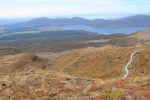
After a climb to the North Crater, followed by a zig-zagging trail down the mountain, we reached the Ketetahi Hut (bathrooms) around 3:45pm. A sign told us it was only(?!!) two hours more to the car park. Who’s idea was this?!!

We had to finish. One step at a time. We walked and walked, resting on each large boulder we encountered. The brush turned to trees and at last we came to an opening with a sign – the carpark?!!! Umm, no. The sign said 45 minutes to the car park. In two hours, we had only come half way!

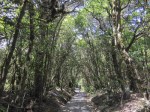
If you’ve ever had knee problems, you know that the only thing worse than going downhill is going down steps. Well, that’s what the remainder of the trail was made up of. Slowgoing, it was steps, uneven trail, steps, uneven trail. Will this trail ever end? Every time we went around a corner, there was another series of steps or another long, rocky path through the woods. The number of hikers passing us by dwindled. It was getting late.

Alone on the trail, we came to a fork with a sign: a symbol of two people, one with a periscope. I assumed it meant “lookout” so we followed the other path. After walking for a while, I began to second-guess my choice. What if it meant something else and I’ve made us walk all this way for nothing? I checked my phone and as expected, we didn’t have any service. The trail app I had downloaded didn’t work either. What if it gets dark? Panicking and praying, I left Frank to amble along, while I hurried ahead down the trail. Tears formed as I rounded a corner and saw the open space of the car park. I ran back to Frank, “We made it! It’s just around the corner!” Twelve and a half hours from when we started, we were finally sitting in our car driving home.

The Tongariro Alpine Crossing. New Zealand’s #1 Day Walk and #1 of the must-dos on the North Island? Yes. The sights were indeed spectacular (now that I look back on the pictures!) and the HIKE — not walk — is a definite must do for experienced hikers or athletic and fearless twenty-somethings. Life-changing? I have just removed hiking Kilimanjaro from my bucket list. Unforgettable? Most definitely.

It stinks, but is oh soooo pretty!

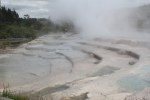
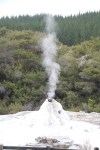
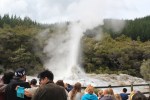
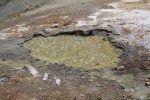
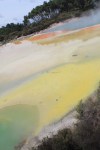
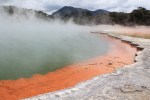
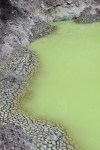
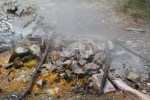
Sitting within the Pacific Rim of Fire, the city of Rotorua is known for bubbling mud pools, shooting geysers and natural hot springs. As we planned our trip, we considered basing ourselves here but were warned about the pervasive odor of sulphur. It wasn’t awful but probably a good decision. And it was an easy hour’s drive from our place in Lake Taupo. We arrived the Wai-O-Tapu just in time for the 10am eruption of the Lady Knox Geyser. I couldn’t figure out how they could time this to the hour and found that they put detergent in the hole! The area was amazingly beautiful. I marveled at the bubbling mud pools and the Artists’ Palette was incredible.

The geothermal areas were/are important to the native Maoris and in Rotorua, you can visit villages to watch people use the boiling water to cook, bathe and warm their homes.

Worms, wonderful worms

What does one do on a rainy day in New Zealand? Frank and I headed two hours to Waitoma to see something you can only see in New Zealand — a glowworm cave! A cave walk took us through some stunning limestone stalagmite and stalagtite formations while we learned about the insects’ life cycle. We then boarded a boat and travelled in an eerie silence through a dark cave, illuminated only by the light of these incredible creatures.

images   Screen-Shot-2014-10-05-at-6-1.04.04-am2

I pulled the pictures above off the internet as they don’t allow photographs in the caves. Biology lesson time: The lifecycle of a glowworm is 9 months. Eggs hatch in 3 weeks into larvae (midge). The midge drop threads of sticky substance. They emit a light attracting other insects to the threads and then they suck up their prey. They may also feed on other glowworms if they need to. After 8 months, the threads serve to suspend the larvae when it forms into a pupae. The adult glowworm fly emerges after 2 weeks. Females live up to 3 days and males 4, long enough to mate, lay about 150 eggs and continue the life cycle.

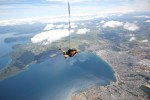
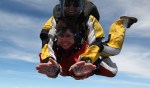
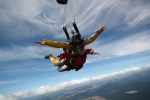
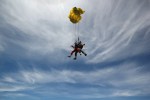
Soaring at 15,000 feet

Dozens and dozens of colorful parachutes dot the skies of Taupo every day. “Would you ever want to do that?” Frank asked. “Never,” I laughed. We both agreed, however, that if you were to skydive, you couldn’t find a more beautiful place to jump than here.

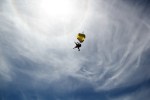
This morning, we heard a small plane and looked at each other. “Are you sure?” Frank smiled, “I don’t want you going home with any regrets.” “OK, why not?” I answered. Before I could change my mind, we made a reservation and drove to the airport.

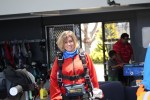
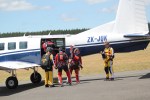
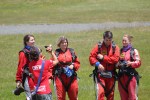
I suited up, met my fellow jumpers, watched the safety video and was introduced to Ryan, the young guy I would be “attached to.” Frank took a few pictures. All good.

Let me say, I am deathly afraid of heights. I hate tall escalators, open staircases, glass-bottomed skyscraper viewing areas and being close to any edge looking down. But I never get nervous flying — and I wasn’t nervous as I boarded or   as the plane took flight. It didn’t faze me as the “12,000-feet” couples jumped off. The plane climbed higher, my partner and I slid forward. We took our place at the edge of the open door. I was directed to look up and smile for the exit camera. SH*&%, WHAT WAS I THINKING?!

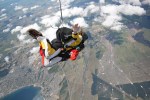
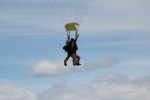
Too late. We flipped out of the plane into free fall! It was cold, my cheeks were flapping. Ryan tapped me on the shoulder. “What did that mean again?” Oh yeah, I can let go of the straps. I did and spread my arms. I was flying! The camera guy flew by – Thumbs up! Smile!
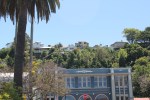
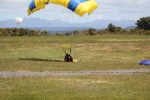
Just as I started to loosen up a little, we were propelled upward as the parachute engaged. The float down was magical — the lake, the mountains — so beautiful! I got a little queasy when Ryan switched directions but surprisingly, the height never affected me. We gently swayed back and forth and before I knew it, we landed.

Although skydiving wasn’t on my bucket list, I am so glad I did it. Next time I’m asked if I want to try something new, I hope I’m not too afraid to say “Why not?!”

Napier and Hawke’s Bay

Today, we headed southeast to visit Napier and the Hawke’s Bay area. The zig zagging road between Taupo and our destination was stunning — evergreen laced mountains, rivers and waterfalls, steep grassy hills dotted with sheep and finally, pretty Napier, sitting on its perch along the Pacific Ocean coast.

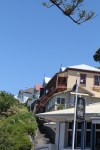
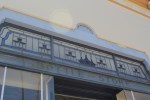
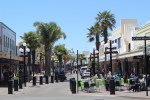
In 1931, a massive earthquake – 7.9 on the Richter scale – rocked the Napier area for more than three minutes. Nearly 260 people died and most of the buildings were demolished. On the positive side, the land rose nearly six feet, draining swampland and increasing the city’s buildable land. And rebuild they did! While the rest of the world suffered through the Great Depression, Napier was quickly rebuilt. New buildings reflected the architectural styles of the times and the city is now known as the world’s most pure art deco city.

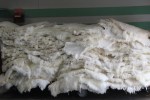
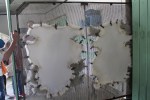
After a self-guided walking tour of the city, we visited the Classic Sheepskins factory. They walked us through the tanning and manufacturing processes of creating their super-soft sheepskin rugs. (Ohhhh, how I wish I had unlimited space in my suitcase!!!)

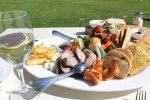
If you’re a wine drinker, no doubt you’re familiar with Hawke’s Bay. Hawke’s Bay is New Zealand’s oldest wine region, famous for some chardonnays but mostly for its reds. Frank and I visited two vineyards. The first, Moana Park, is a highly-awarded boutique winery whose focus is on low allergen, natural winemaking. We asked for a tour and were directed outside to a picnic table, where the two of us sat with our host drinking wine in the warm sunshine. He was passionate and down-to-earth, explaining each selection, along with the vineyard’s wine-making philosophy, in a simple, understandable manner. It was so relaxing and truly enjoyable! Our next stop was New Zealand’s oldest winery, Mission Estate. Established by monks in 1851, it is the birthplace of wine in New Zealand. Nowhere near as warm and welcoming as Moana Park, it was worth visiting in that the building and grounds were gorgeous. We ended our little day trip with wine and a late lunch on the grassy terrace overlooking the vineyard.

Snow Mountain

IMG_7046

A few days ago

IMG_7301

Today

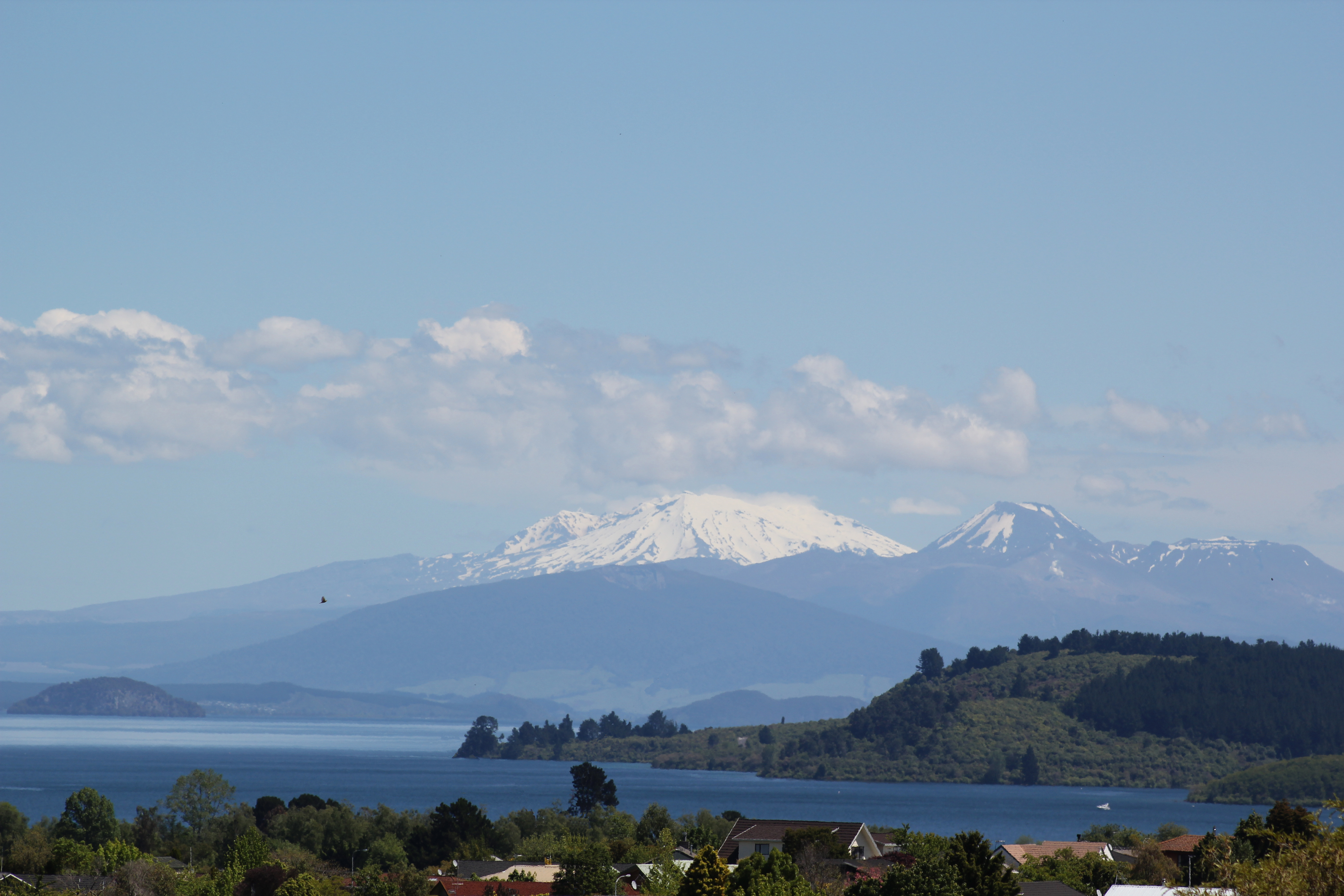
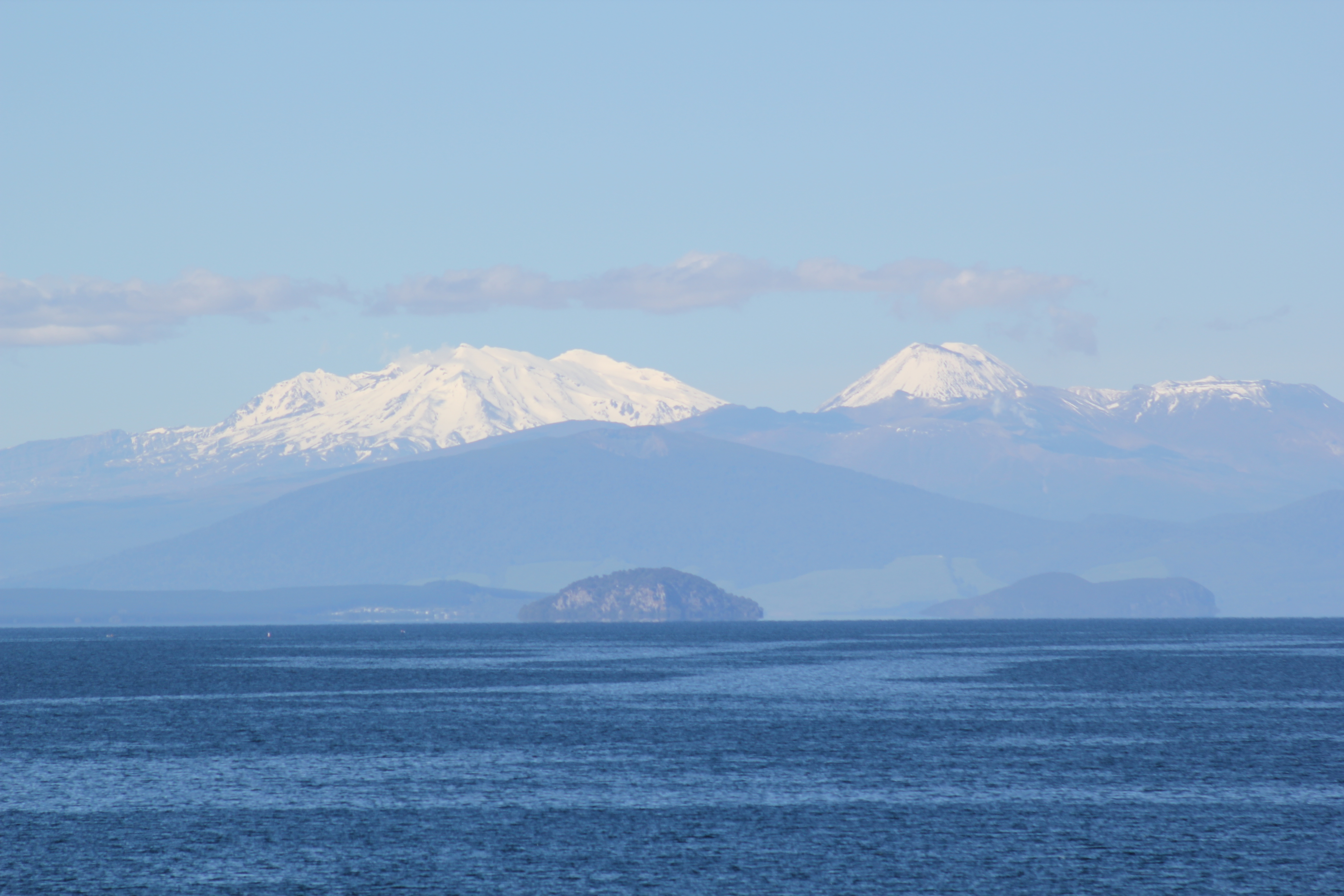
I was hoping for Christmas spirit and the weather got cooler. Frank’s mountain got more snow but none here, thank goodness. Neither of us mind the cooler weather — nice for sleeping and with all the sunshine, it feels warmer. Great for sightseeing, just peel off the clothing layers as the day goes on…

Auckland, the City of Sails

As mentioned in the previous post, Frank and I spent last weekend in Auckland. We hadn’t planned to visit another big city so soon after Australia but the draw of a Christmas Parade was enough to change my mind — and then Frank’s!

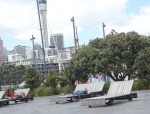
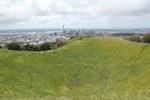
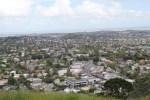
We discovered that the city is much more than tall buildings and lots of people. What makes Auckland unique is its geography. The region lies on an isthmus between two harbors with almost 2,300 miles of coastline. It is the only city in the world built on a still-active volcanic field and the region is dotted with 48 volcanic cones, many of which provide panoramic views of the city and harbor. A lot of the nearby islands are part of Auckland City and one of them, Rangito Island, was formed by two eruptions just 600 to 700 years ago. (More about volcanos at the end of this post.)

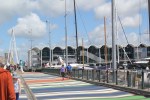
Auckland is New Zealand’s largest city and is home to 1.4 million people (30% of the country’s population).  They all live within a half an hour of a beach, which may explain why 1 in 3 families own a boat and why the city is known as the “City of Sails.” Frank was impressed by all the activity along the waterfront. I was a fascinated by the volcanos and how hilly the city was — even more so than San Francisco. We were surprised to find out that Auckland is the largest Polynesian city in the world but weren’t surprised that it was recently rated the world’s fourth best city in which to live!

More about volcanos: You are probably wondering why anyone would live here among all these volcanoes. While the volcanos in the center of the North Island (i.e. near Taupo), are more explosive and are the result of the movement of tectonic plates, the volcanos in the Auckland area are far less dramatic. The Auckland Volcanic Field is monogenetic, which means each volcano usually only erupts once. The field itself is considered active but dormant. There is no way to predict where or when the next ‘bubble’ of magma will rise to the surface and create a new volcano but no one seems to be that worried about it.

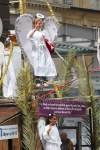
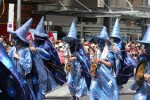
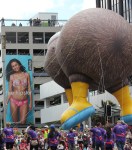
Auckland Christmas Parade

Dedicated to Jane, my parade buddy…